
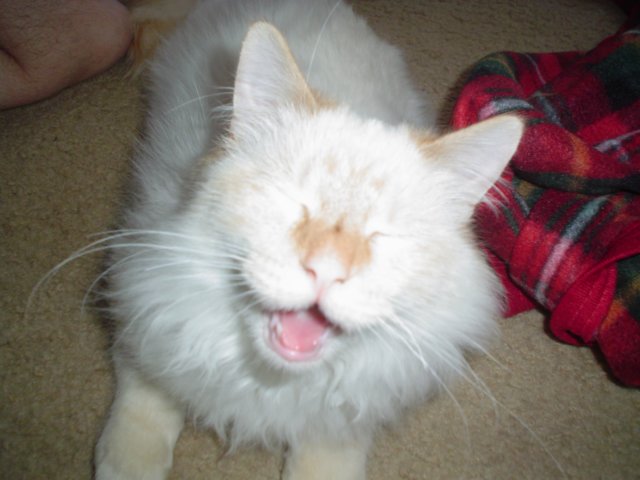
One of the first pictures I took of Puck. I used my Sony 3.2 megapixel camera.
Note from Irene: A former editor once told me not to include more than 10 pictures in a post because people will lose interest. I’m breaking that rule today.
Paul and I made a trip to the Panhandle Humane Society to sort out the final details of our cat, D’Argo, who had been tragically struck and killed by a vehicle on Highway 71 near the University’s Panhandle Research Center. Before we went in, I specifically mentioned we needed to wait a while before we got another cat.
While I was speaking to some folks inside, one of the employees spoke with Paul, expressed her condolences and then said she knew what would help. She went in the back and came out with a 9 month old Flame Point Siamese cat. I looked at Paul’s face when she placed the cat in Paul’s arms.
“Damn it. We have another cat,” I said to myself.
This was Puck. He was rescued by a state trooper, who had found him with a broken leg. Puck’s leg was permanently fused in the shape of a hockey stick, hence the name, Puck. Unfortunately, his leg could not be saved and Puck. He had arrived at the Humane Society on November 22, 2009. We took him home on January 22, 2010.

One of my favorite pictures of my cat, Puck.
We were given careful instructions for his continued healing and were told Puck would not be able to do stairs. His food, water, and litter box would all need to be on the same floor. Paul held Puck in his arms as I drove us all home that day.
After unlocking the front door, I headed over to the closet to put away my jacket and shoes. Paul did the same. I looked around, but didn’t see Puck. I asked Paul where he was. Paul shrugged. I panicked.
I ran around our place looking for him. It only took a few seconds. Our place wasn’t that big. I thought maybe he went downstairs, which would be easy with three legs. Getting back up would be much more difficult. Nope. No cat in the basement. While it didn’t seem possible, I went upstairs. Sure enough, Puck was wandering around our bedroom. “Can’t do stairs, eh?” I said to Puck.
I went over to him and petted him, then returned downstairs. I listened carefully and, sometime later, he came down the stairs. I cautiously watched, just in case he struggled.
That was the thing. Puck never really struggled. He adapted. Over the years, he climbed into my fridge. He climbed onto my computer chair. He climbed on the couch. He climbed up onto kitty city. He played with our other cats. He ran around the house. He just got on with life.
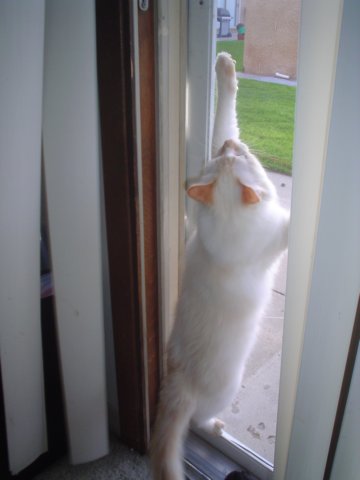
Puck also climbed the screen on the back door.
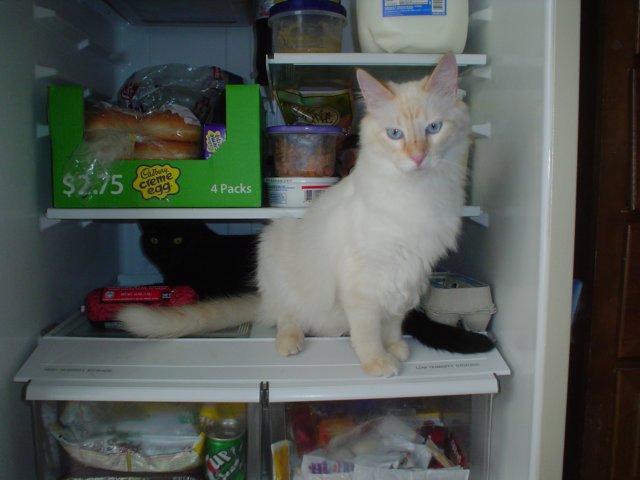
Puck also figured out how to climb into the fridge.
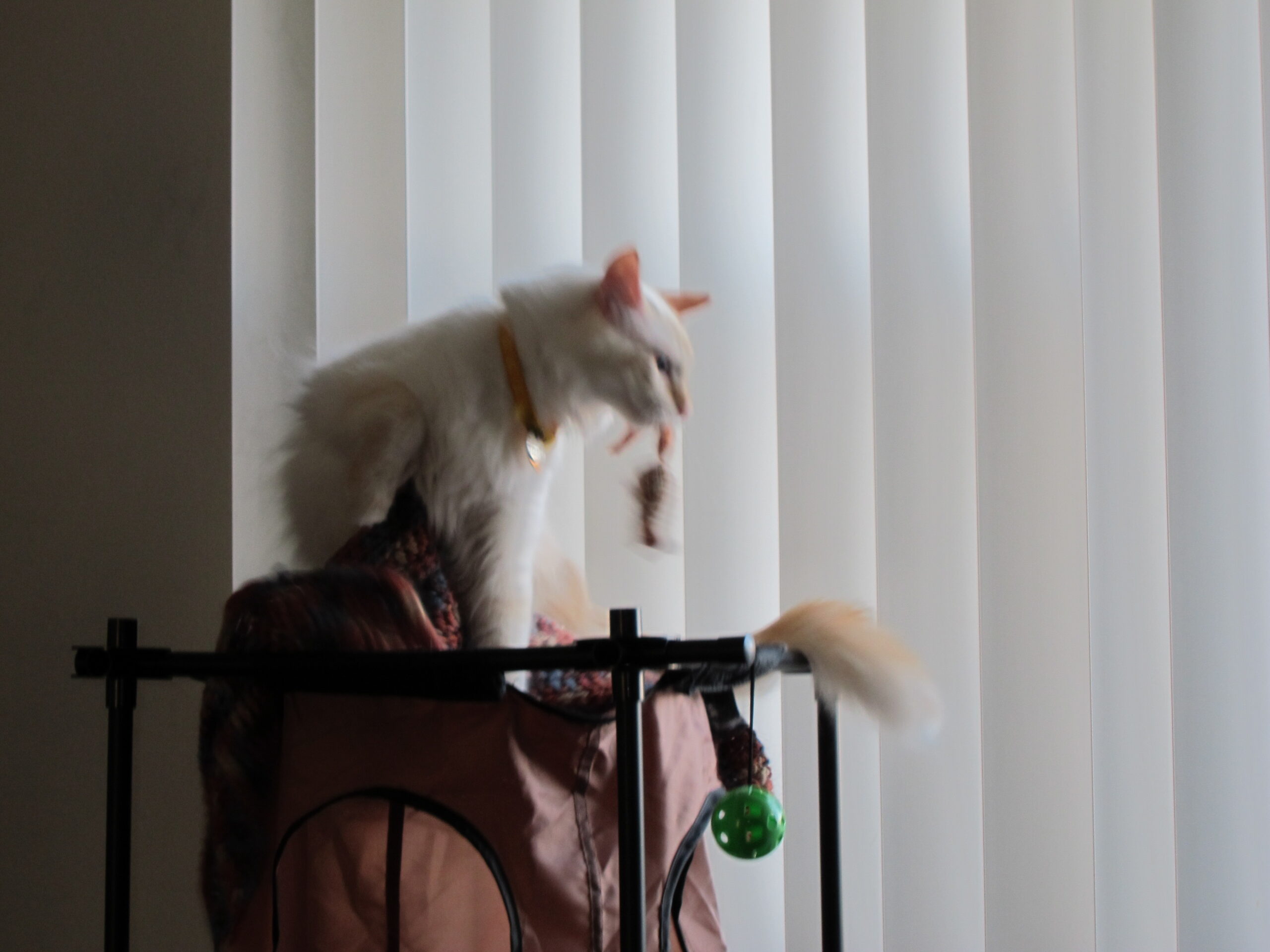
Not a good photo for sure, but Puck climbed to the top of the 5-foot high kitty city with his “mouse” in his mouth.
We found out several years later that Gayle Rojas had paid for Puck’s surgery. I was having a casual conversation with Gayle and I mentioned my three-legged flame point. We put two and two together. Her generosity provided Puck with a second chance at life and an opportunity for us to care for him.
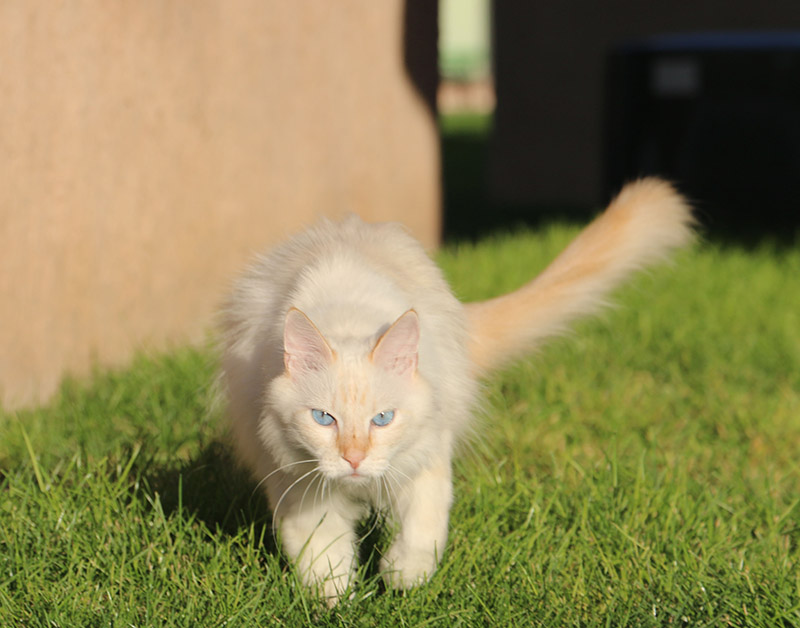
Puck was not allowed outside without us. Paul let him out and he greeted me when I came home from work.
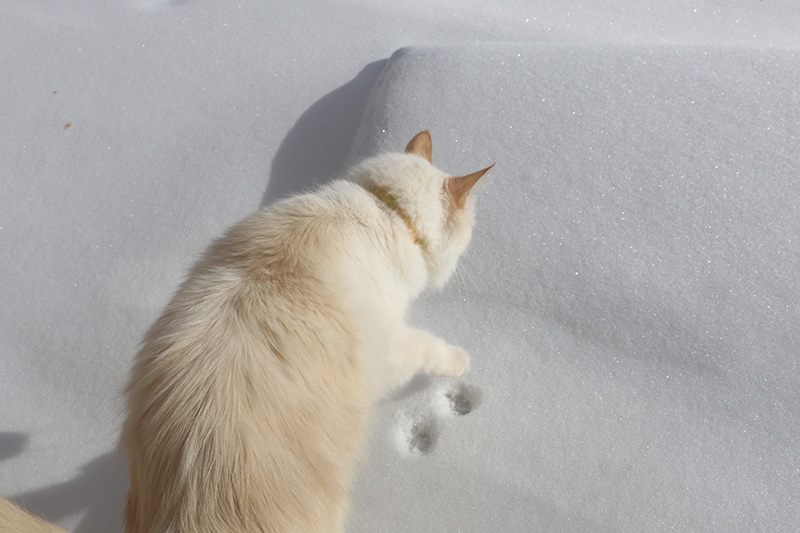
Puck did not liked being outside, but not in the snow.
When we moved to our new house, he could still do the stairs, but it took him a little longer to get back up them. Eventually, climbing the stairs from the basement became a struggle. He would do one stair, rest, one stair, rest, until he got to the top. If I saw Puck go to the basement, I would keep an eye out for him and when he was ready to come back upstairs, I would scoop him up and carry him to the top.
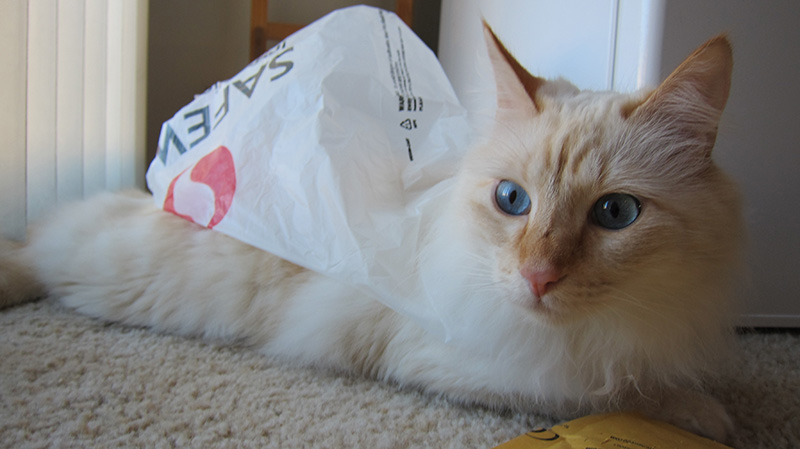
Puck always had one kind of bag or another stuck on him. He loved climbing into them, but always got his head into a handle. His “cape” bounced around as he ran around the room.
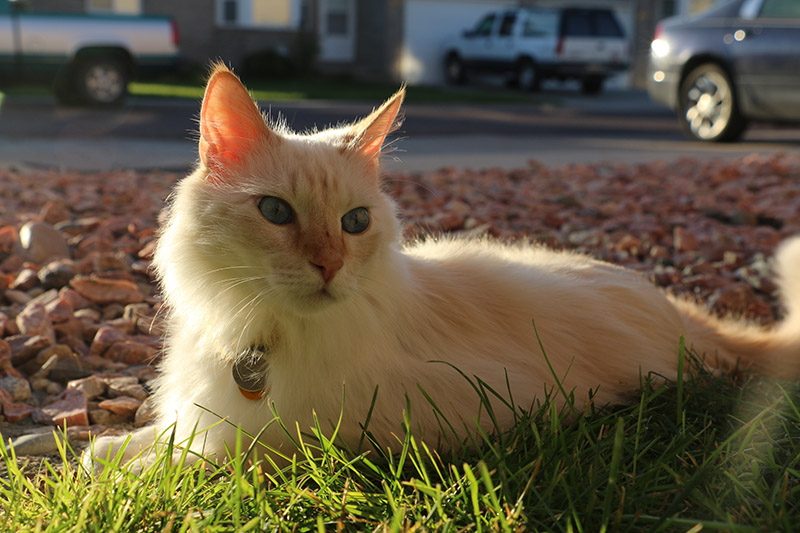
Puck basking in the cool, fall air on October 14, 2015.
The last couple of years, he stayed on the main floor. We got a two-step foam cushion for him to get on the couch. He was slowing down with age. If I put him in my computer chair, he would nap in it as always, but he couldn’t get himself into it on his own anymore.
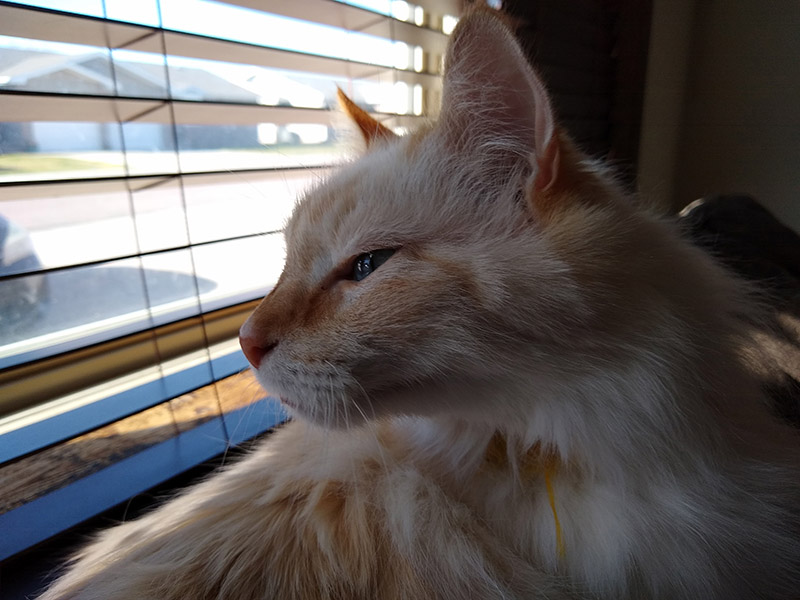
A second favorite picture of Puck, taken on my cell phone on Nov. 4, 2020, which doesn’t usually get good pictures.
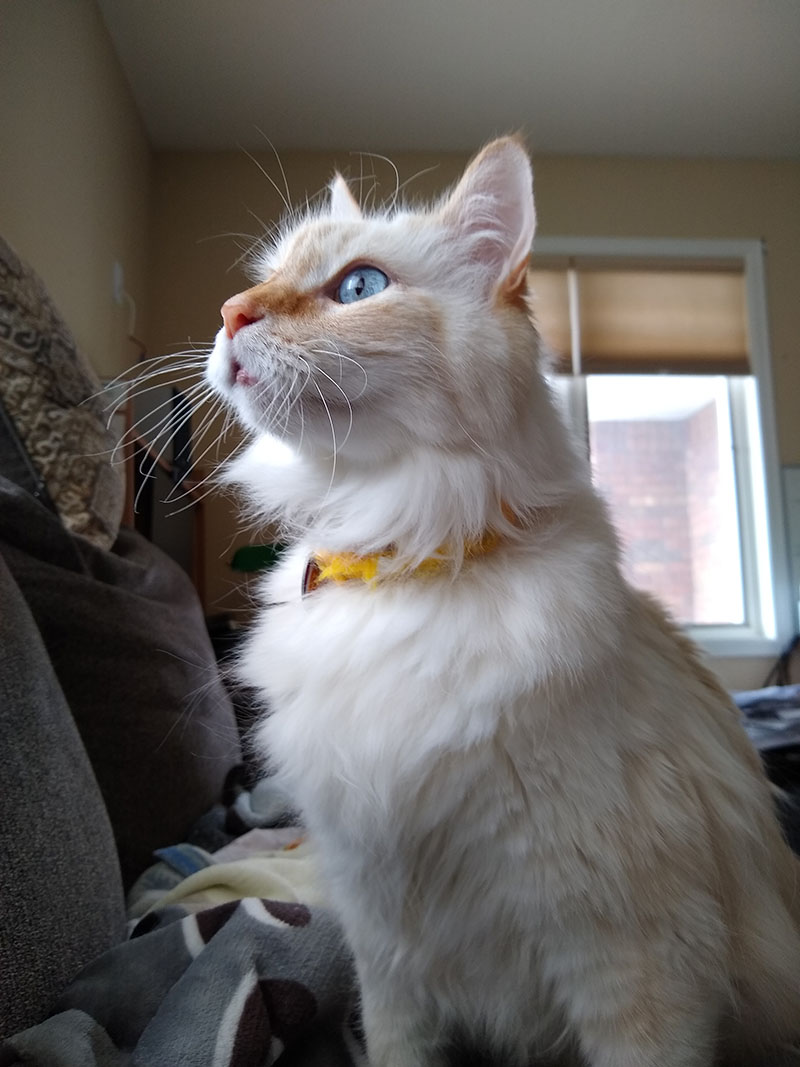
Puck looks out the window shortly after we moved into our new home.
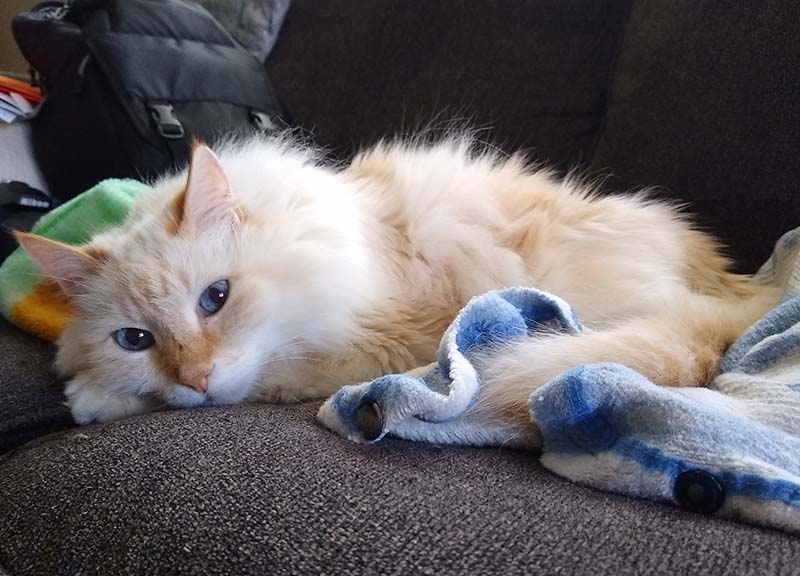
Puck on the couch.
He never lost his appetite, which was one of two things we knew were wrong. On Saturday, September 12, 2026, I went hiking with a friend in the Black Hills. Puck had walked over to the a/c vent the night before and sat over it. He looked like he was panting, but just held his mouth open. After a few minutes, he returned to his usual sleeping spot next to my computer desk. Paul texted me on the 13th on my way back home. He said Puck didn’t hadn’t eaten since I was gone and he “did the mouth thing” again.
We called the vet first thing Monday morning and got an appointment for 3:30 p.m. Puck didn’t eat anything all day, but he did have some water. You can’t really prepare yourself for these things even if you lie to yourself and say you will be fine.
Puck was always a good boy in the car. He rarely meowed and often hid under my driver’s seat. Whenever we came back from the vet, we opened the car door and watched him race back inside the house.
Dr. Upp came into the exam room and looked at Puck. He checked Puck’s heart. I knew by the “hmmm” and the shifting microscope something was definitely wrong. Dr. Upp said he was having trouble finding Puck’s heart. It was “fuzzy.” He said something else that didn’t quite register other than it was a common thing. I thought I heard the word tumor. Then, he asked if he could take an x-ray. Of course we said yes.
Several minutes later, Dr. Upp returned without Puck. His face and his body language said it all. He said it was a tumor and it was crushing Puck’s lungs. He told us to come back into the x-ray room with him so he could show us.
Puck was chilling out with one of the employees. Dr. Upp showed us the tumor. It was huge. You could visibly see where one lung was crushes to just a bit more than half its normal size. I couldn’t see Puck’s heart. Dr. Upp had to show it to us.
I asked what the next step was, already knowing what the answer way. Dr. Upp offered two options, the one I knew we were destined to take and one which might help. Puck could get a steroid shot which “might help for a short time.” It was the tone in his voice and how he grimmaced when he said those words. Paul had completely shut down.
Dr. Upp explained that, unfortunately, this kind of tumor doesn’t let you know it’s there until it’s too late. We had noticed the breathing issue three days before. Okay. I paused for a moment. I was desperately trying to get the words out while processing all the information that was just delivered.
Dr. Upp’s voice filled that momentary silence. Dr. Upp, who never tells anyone what they should do in this situation mentioned if it was his cat, he wouldn’t try the steroids. “Might” and “short time” in the tone and delivery said to me “probably won’t” and “hours or days.”
“I don’t want him to suffer,” I said. Paul slightly nodded his head. You can’t prepare for this. I’ve had 10 pets pass on before I even met Paul in 1993. Together, we had three pass. Each one hits you differently. Each one takes a piece of you. Paul never had pets before we married. It’s still a fresh and new experience.
It was hard to talk and not cry. We all went back to the exam room with Puck to say goodbye, while Dr. Upp prepared the medicine. We talked to Puck and petted him. Paul took a few photos of me saying goodbye. I didn’t hold back the tears.
When Dr. Upp came back into the room, we had a little chat. He remembered the first time we brought Puck in and what a cute kitten he was. He reminded us that we gave Puck the best life he could have. We did. We spoil our cats, all of which have been rescues of one type or another.
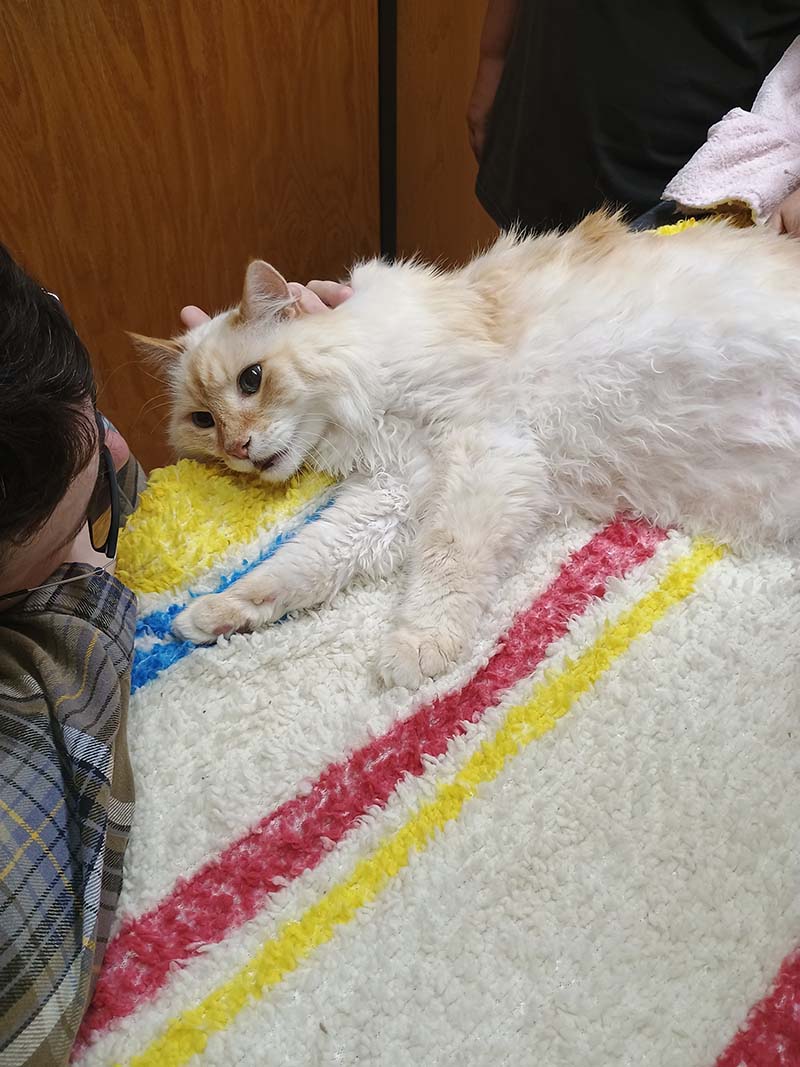
Puck listens to me as I say goodbye, stroking his head one last time.
I squatted down to Puck’s level again so he could see my face. I stroked his head between his ears. Then, his head fell off the edge of the table and into the palm of my hand. I gently held him for a moment and then rested his head back on the table. Puck passed away at 3:45 p.m., on September 14, 2026. He was 17 years old. Dr. Upp and his assistant left the room. We said our goodbyes.
Puck on his last car ride with me.
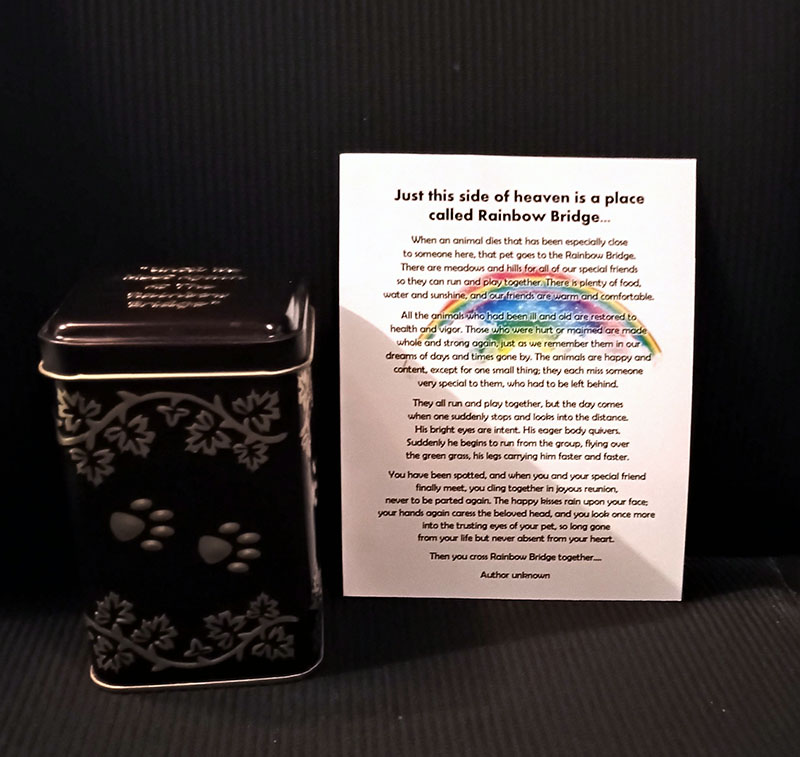
A couple of weeks later, I drove to the Panhandle Humane Society to pick up Puck’s ashes. I put his urn in the passenger seat. In between shifting gears, I held his urn tightly against the back of the seat. We took our last ride together.
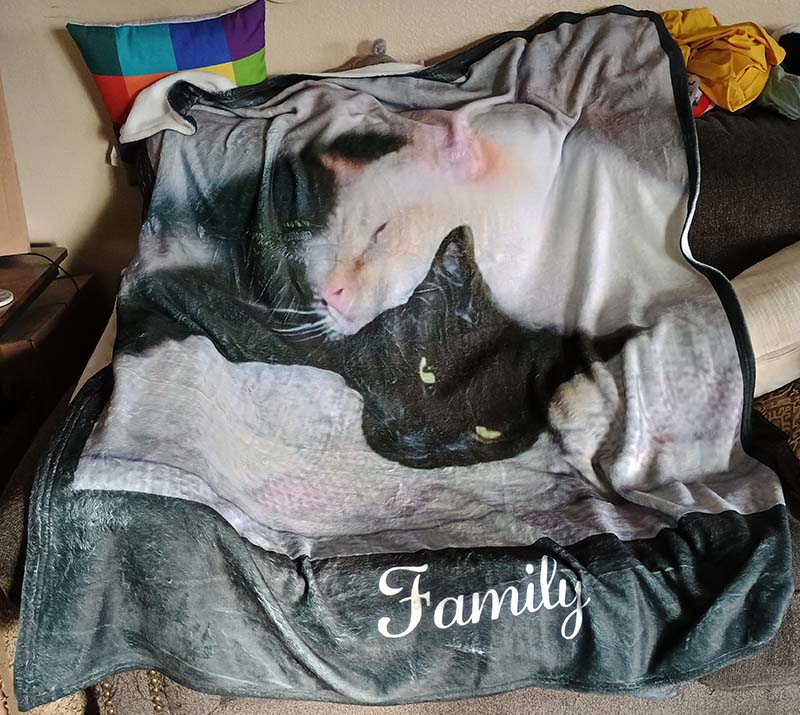
An anonymous gift to remember our cats, Puck and Harvey.
On October 2, 2026, a package arrived. Inside were two identical blankets. It has the pictures of Puck and Harvey, which Paul is currently using as his main Facebook pictures. We don’t know who sent it, but it is one of the kindest gifts I’ve ever received.
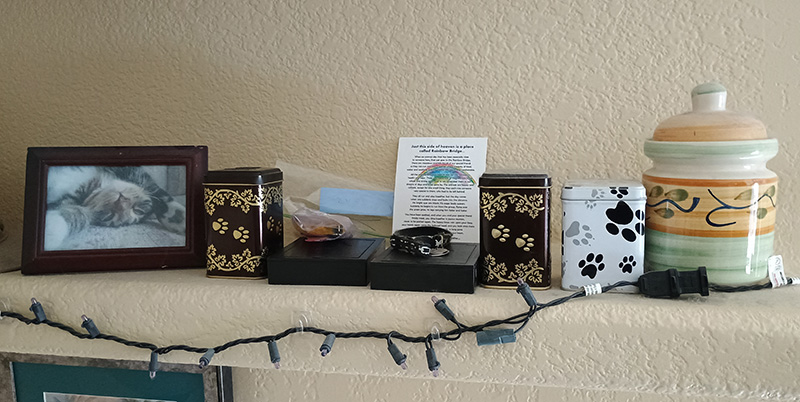
Our cats are always with us on the mantle above my computer desk. From left, picture of D’Argo, Puck, Puck’s paw print, Harvey’s pawprint, Harvey, Cinders, and D’Argo.
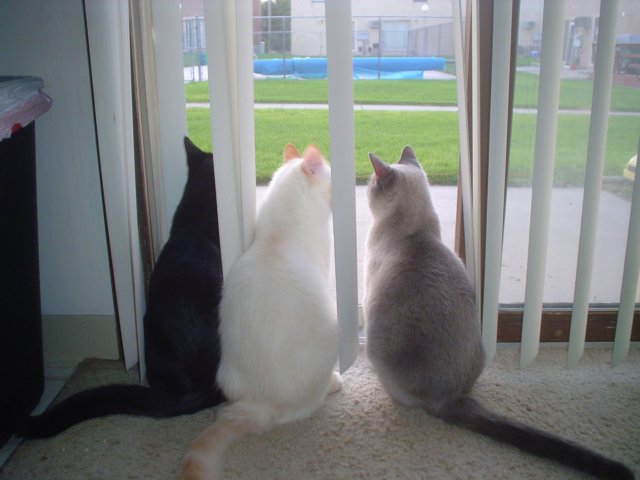
Harvey, Puck, and Cinders look outside the back window.
Puck is at rest now. He is kept company with D’Argo, Cinders, and Harvey, who all passed before him. He was the best three-legged kitty I ever had.